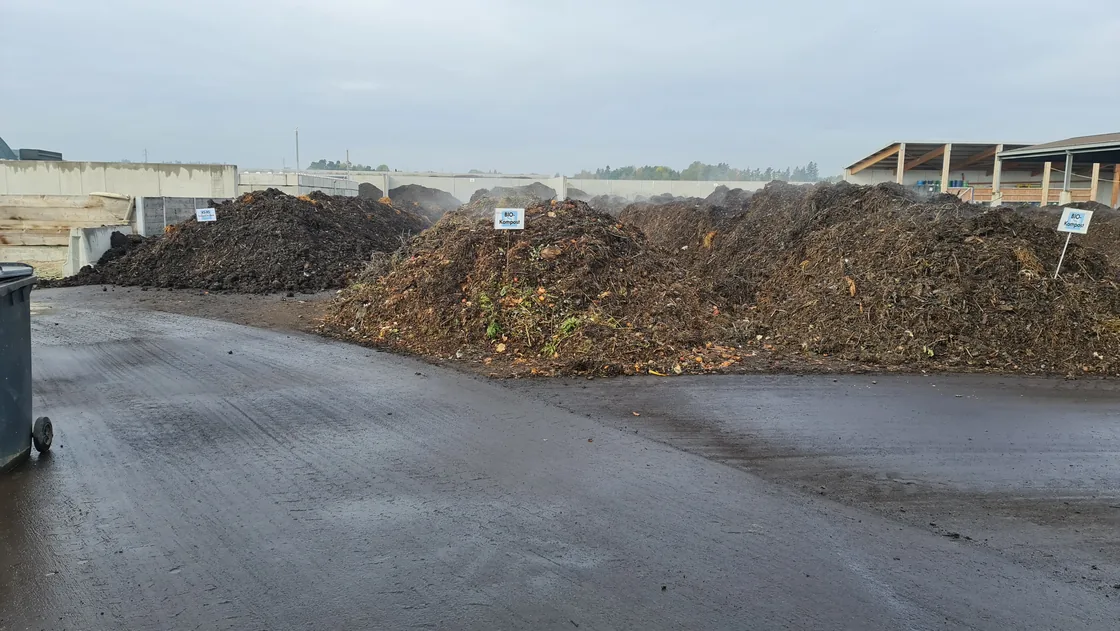
A facility accepts defined streams that it can treat and turn into material fit for its intended outlet. The label “organic” is not enough. Two loads with the same description can differ in moisture, woody content and contamination. Intake is the point at which an uncertain load can still be kept separate. Once it has been blended, you cannot separate the original loads again; with good traceability, you can still identify all the affected batches. [1, 2]
1. What to find out about each stream before working out the recipe
Water and dry matter. Wet-basis moisture tells you how many kilograms of the load are water. Dry matter includes the organic and mineral fractions; on its own it does not tell you how much can break down. For dosing, use data from the batch or a representative sample of the stream, not just a catalogue value. [1, 3]
Structure and bulk density. Bulk density relates mass to the volume it occupies, including the voids between particles. It depends on how the material was placed or packed. Compare values obtained by comparable methods under comparable conditions. Particle shape and rigidity matter too: wet fresh grass can mat into layers, whereas rigid wood chips can keep pathways open for air. The wood may, however, break down more slowly than the soft plant fraction. [1, 5]
Composition and origin. Check whether the load adds readily degradable material or mostly fibrous material, what carbon and nitrogen it contains, and what might have been mixed with it at source. For sludge or digestate, the name is not enough. Find out where it came from, what properties it has after any dewatering, and whether it meets the site's intake conditions. Check the eligibility of the incoming stream separately from the intended outlet; this article does not list authorised feedstocks. [1, 2]
2. Why you remove physical contaminants before size reduction
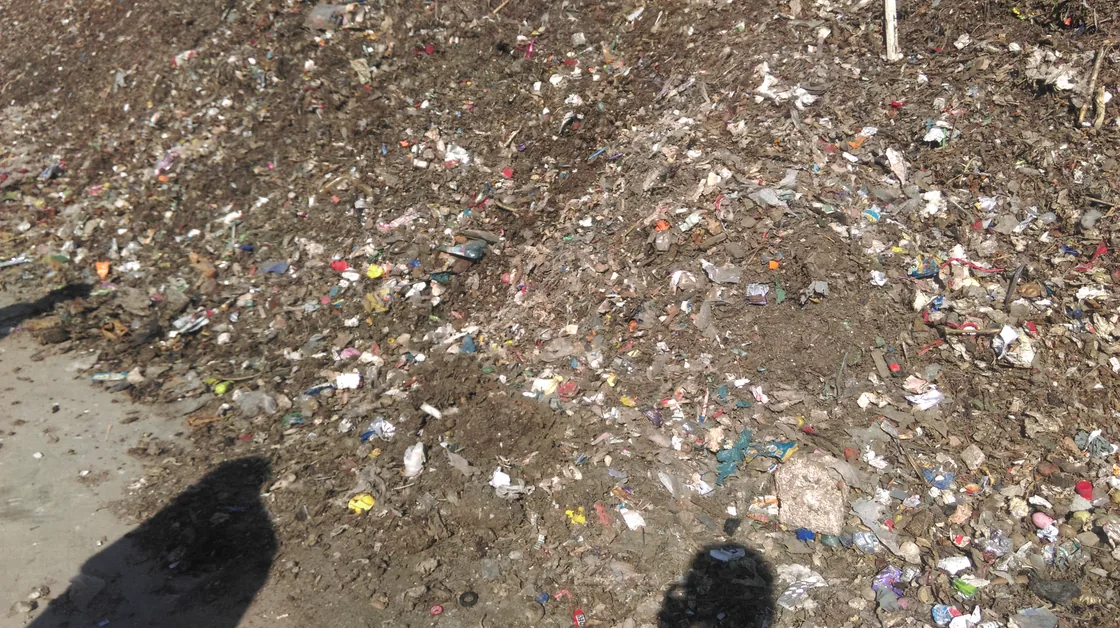
Glass, stones, metals and plastics behave differently. A screen separates by size, not by material. If a piece of plastic or glass breaks up during handling or size reduction, fragments that fit through the openings can enter the fines. As composting breaks down part of the organic matter, persistent objects can become more conspicuous without having been added during treatment. A study that tracked one industrial plant before and after shredding and screening found plastic particles even in the finished compost. It shows a limitation of mechanical separation, not the removal efficiency of every installation. [3, 4, 5, 7]
Require sorting at source, record which deliveries repeatedly arrive with contaminants, and remove foreign material as early as practicable in the approved process. Final screening is not grounds for accepting a load outside the acceptance criteria.
3. What you cannot see in a load
Grass clippings, hay and manure from animals fed treated forage can introduce persistent herbicide residues. Oregon State University documents examples including clopyralid and aminopyralid, which can persist through composting and distort growth in some broadleaf plants. Normal colour and odour do not rule them out. [6]
If the origin gives cause for concern, obtain the relevant history and hold the load separately, if the procedure allows, until a decision has been made. A bioassay with a sensitive plant such as peas compares growth in the suspect material with growth in an uncontaminated control under similar conditions. The test can flag a problem; it cannot on its own identify the substance or replace targeted analysis or batch release criteria. An assay for suspected herbicide residues is not the same as a general maturity test. [6]
4. Worked example: same load weight, different dry matter
Assume two loads of 1,000 kg each. Moisture is on a wet basis, and the values are assumed to represent each load.
| Material | Moisture | Water | Dry matter |
|---|---|---|---|
| A | 70% | 1,000 × 0.70 = 700 kg | 300 kg |
| B | 30% | 1,000 × 0.30 = 300 kg | 700 kg |
The difference is 400 kg of dry matter. These figures cannot tell you whether B provides more readily degradable material, more resistant wood or simply more minerals. The calculation gives the water and dry matter contributions; the rest requires feedstock characterisation. See moisture and dry matter and mix preparation.
5. What you see, what to check and what to do
| At intake | What to check | Possible decision |
|---|---|---|
| The same category of green waste arrives after rain | Moisture, free water, bulk density and the share of fibrous material, using representative samples | Adjust the recipe for the accepted load rather than automatically repeating last week's dose. |
| Visible plastic, especially in one part of the load | The extent and source of contamination and the site's criteria; record the suspect area separately | Do not hide the problem by blending with clean material; follow the procedure for a nonconforming load. |
| A load looks clean but its agricultural origin is unclear | Supplier, relevant use history and, if the risk warrants it, a suitable bioassay or analysis | Hold it out of the recipe until the issue is resolved; follow the acceptance or rejection procedure. |
For each delivery, keep at least an identifier, source, date, mass, observations, the decision and the link to the composting batch. One sample from the top cannot describe a heterogeneous load. Decide what you are sampling for: use a representative sample to estimate average moisture; record and investigate a local anomaly separately. See the facility workflow and compost quality. [1, 2, 3]
References and further reading
- NC State University Extension. Large-Scale Organic Materials Composting, “Feedstocks”, “Surface area” and “Testing”
- European Commission. Commission Implementing Decision (EU) 2018/1147, BAT 2 and BAT 33; intake checks, traceability and selection for installations within its scope
- Oregon State University Extension. Interpreting compost analyses, dry matter, organic matter, sampling and inert contaminants
- Peneva et al. Plastic input and dynamics in industrial composting, Waste Management 193 (2025), pp. 283–292. Single-facility study, not a quality standard
- US EPA. Approaches to Composting, “Pile Structure” and “Pre-Processing Technologies”
- Oregon State University Extension. Herbicide-contaminated compost and soil mix, mechanism, sources and example of a bioassay with a control
- International Compost Seminar 2026, Austria. 7 October (day 3), “Raw Material Handling”, PDF pp. 6–7, 9 and 32. Organised by Compost Systems GmbH.