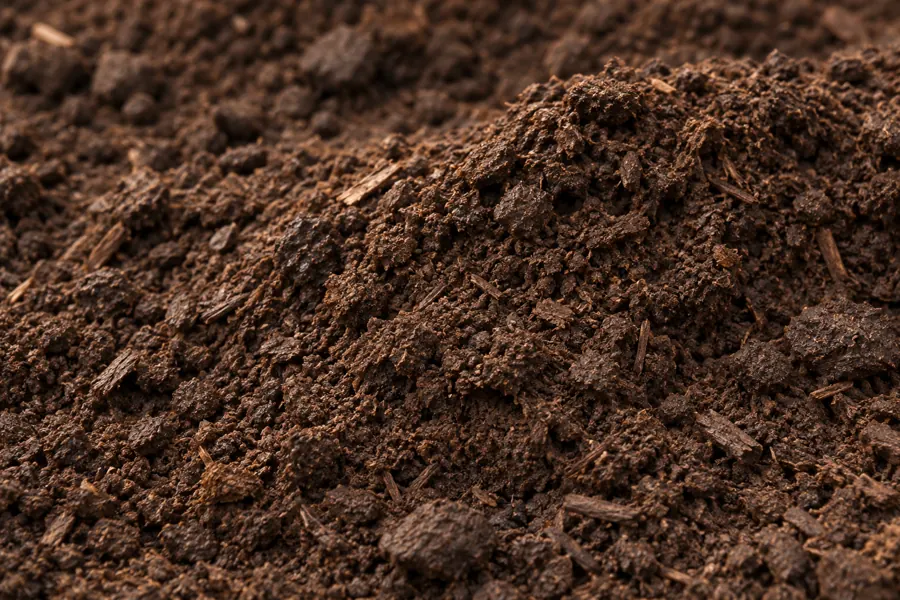
Dark, screened compost with no strong odour may still be unsuitable for seedlings or for a particular field application. To judge quality, find out how much biological activity remains, how plants respond to the material and which other properties matter for the intended use. Each question calls for different checks [1].
Stability, maturity and quality: three different questions
| What you assess | What it means | What to check |
|---|---|---|
| Biological stability | How actively the material continues to decompose under defined test conditions. | Respiration in an incubated sample, for example the amount of CO₂ released over a defined period. Interpret the result with its method, units and reporting basis. |
| Maturity | How far curing has progressed and whether the material can still harm plants. A stability test contributes to this assessment but cannot replace it. | Combine respiration results with indicators such as ammonium nitrogen and nitrate nitrogen, or with a germination and early growth test against a control. |
| Quality for the intended use | Whether the product has suitable properties and meets the specifications for the actual application. | As relevant, check salinity, pH, nutrient content, particle size distribution, physical impurities, chemical contaminants and microbiological indicators. |
A respiration test measures activity under controlled conditions. A cool windrow is not equivalent to that test: the material may be dry or have cooled at the surface without becoming stable. Even a low respiration result needs context. In some samples, ammonia can suppress microbial activity during the test. A low C/N (carbon-to-nitrogen) ratio may come directly from nitrogen-rich feedstocks and does not, on its own, establish maturity [1, 3].
During curing, when conditions favour nitrification, microorganisms can convert ammonium to nitrate. Changes in these forms of nitrogen can help interpret stability and plant test results. Do not compare a value expressed as nitrate nitrogen (NO₃-N) with one expressed as mass of the nitrate ion (NO₃⁻) without expressing both concentrations on the same chemical basis and checking that both are expressed on the same mass basis [1].
Start with the application rather than a standard list of tests
In a seedling growing medium, young roots are exposed to the mix in a small volume. Salinity, pH, particle size distribution and plant response at the intended compost inclusion rate all matter. In the field, soil test results, the application rate per hectare and how compost is incorporated also matter. The same laboratory result can have different implications in these two situations. Do not change the intended use on the strength of one indicator [1].
For example, EC (electrical conductivity) indicates the level of soluble salts, but depends on how the extract was prepared. A result from a 1:5 compost-to-water extract cannot be compared directly with one from a saturated extract. Before putting two readings in the same table, check the method as well as the units. For nutrients, check whether the laboratory reports concentrations on a dry matter basis or on the wet, as-received weight [1].
Sample the batch you want to characterise
Identify the batch and its stage before sampling. If the method allows a composite sample, take increments from across the batch, including interior locations where safe and specified, then mix the increments as the protocol directs. Do not combine separate batches. A composite characterises the batch within the scope of the sampling plan but does not rule out a local problem; an area of concern may need a separate sample. A grab from one surface location may describe only that spot [1, 2].
Agree with the laboratory which tests are needed and confirm the sample quantity, container, preservation and transport requirements before collecting it. Keep the batch identifier, sampling date and method, analytical method, units and reporting basis with the laboratory report. If two apparently comparable results differ widely, first check whether the samples were taken from the same batch, how they were collected and whether the laboratories used the same method [1, 2].
Worked example: from dry matter percentage to kilograms per tonne
Illustrative assumptions: one tonne of wet product (1,000 kg) contains 40% moisture on a wet basis. On a sample representative of that tonne, the laboratory reports organic matter of 50% of dry matter.
- Dry matter: 1,000 × (1 − 0.40) = 600 kg.
- Estimated organic matter: 600 × 0.50 = 300 kg, or 30% of the wet product weight.
If the laboratory used LOI (loss on ignition), the 300 kg is an estimate based on the mass lost during the test. Other constituents, such as mineral-bound water or plastic fragments, can contribute to that loss. The result does not quantify the biodegradable fraction or tell you whether the product is mature [1]. See also Moisture and dry matter.
When observations and test results do not agree
| What you observe | What to check before drawing a conclusion |
|---|---|
| Material heats up again or develops an odour in storage. | Check moisture and aeration in the stockpile. Assess whether the batch still has a high respiration rate and needs more curing; odour alone does not establish the cause. |
| Respiration is low, but seedlings grow poorly. | Compare with the control and check the compost inclusion rate, salinity, pH and forms of nitrogen. If contamination is suspected, ask the laboratory which test could address the specific concern; poor germination alone cannot identify the cause. |
| Plastic or glass is visible despite good biological results. | Check physical impurities and trace them back through intake and screening. Biological results do not verify physical cleanliness. |
To accept a batch, check the specification for the intended use separately from the requirements for the applicable product category. Stability, maturity and a favourable plant test do not prove the absence of contaminants or demonstrate microbiological compliance. This article explains how to interpret results; it does not set compliance limits or replace a batch release decision. Separately check temperature and sanitisation, feedstocks and contaminants and the facility workflow.
References and further reading
- Oregon State University Extension. Interpreting compost analyses, sections on methods, stability, maturity and additional tests
- Moore, de Haro-Marti and Chen. Sampling Dairy Manure and Compost for Nutrient Analysis, PNW 673, principles of representative sampling for dairy manure compost, not a universal sampling standard
- NC State Extension. Large-Scale Organic Materials Composting, sections on moisture, temperature and the active phase
- International Compost Seminar 2026, Austria, day 5. “Compost Analysis and Nutrient Cycle”, PDF pp. 4–8, 11, 13 and 16, checked in the text extract; sampling, dry matter and tests specific to the method presented. Organised by Compost Systems GmbH.