A windrow heats up when microorganisms break down enough organic matter in the presence of oxygen to generate more heat than the pile loses. Temperature helps track biological activity. To assess sanitisation, look at the batch’s exposure to heat, not just the peak temperature at the centre of the windrow.
Why the material heats up and cools down
At the start, microorganisms use readily degradable compounds. As the material warms, organisms adapted to higher temperatures become more active. The FAO (Food and Agriculture Organization of the United Nations) guide describes mesophilic activity at approximately 20–45 °C and thermophilic activity at 50–70 °C. These are biological ranges from an agricultural guide, not process control limits or sanitisation criteria. The phases and their boundaries vary with the mix [1]. See Microorganisms and composting phases.
Temperature reflects both heat generation and heat loss. Air moving through the pile carries away heat and water vapour. Turning redistributes the material and can cool the windrow immediately. If it restores oxygen to a mix that is still active and moist enough, the temperature may rise again. Cooling at the end of the active phase can be normal. In a fresh batch, the same observation may point to dry material, uneven airflow or high heat loss [1, 2]. If some zones cool faster than others, check moisture and material structure: air-filled porosity can vary within a batch and contribute to uneven airflow.
How to verify thermal sanitisation
Heat exposure can reduce certain unwanted microorganisms and the viability of some seeds, but the effect depends on the material, temperature, duration and distribution of heat. The core and edges of a windrow do not necessarily follow the same temperature profile. Turning can move material from the outside to the inside. A record of the turning event alone does not prove that material was redistributed adequately. In a tunnel, the monitoring plan needs to account for the shape of the load, air distribution and areas prone to cooling [2, 3].
Process validation assesses whether the method and plant configuration can deliver the intended exposure under the operating conditions evaluated, including in vulnerable zones. Batch monitoring then documents the conditions recorded during each treatment. For a particular facility, check the requirements that apply to its feedstock, technology and permit. Depending on those requirements, particle size, operating mode and microbiological checks may also matter. Keeping untreated material separate from treated batches, including controlling transfer via equipment or runoff, reduces the risk of recontamination. Sanitisation does not mean sterilisation: neither the temperature history nor the result from a single sample guarantees the absence of unwanted microorganisms throughout the batch [2, 3].
What to record at the plant
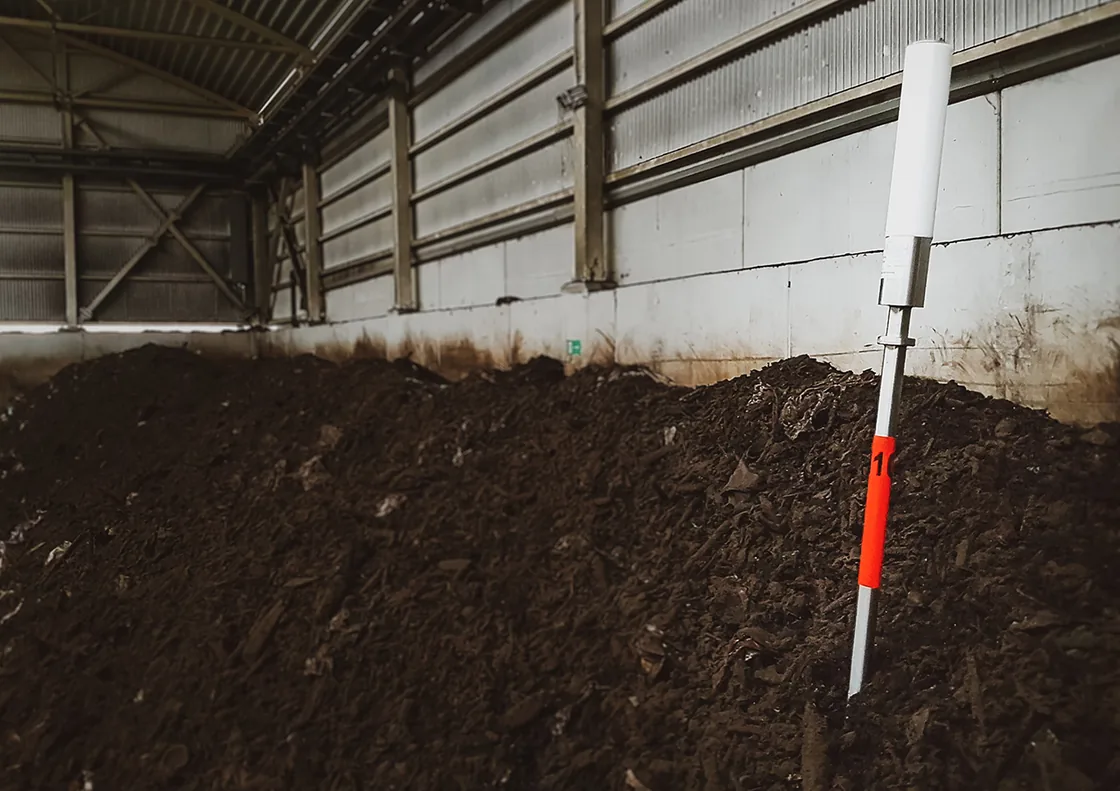
Select measurement locations and depths for the batch geometry and the results of process validation. Measure the material itself, not the ambient air or exhaust air. Those air temperatures can be recorded separately for troubleshooting. Use identified probes calibrated and checked in accordance with the plant’s procedure. For each reading, record the batch, date and time, location and depth. Log turning, watering, aeration changes and interruptions. If a probe stops recording, flag the missing data. Do not fill a gap with an average from other locations or assume that the target was met [2].
Worked example: a 61 °C core does not describe the entire windrow
Illustrative assumptions: three readings at the same time on consecutive days show 61 °C at the centre and 48, 50 and 52 °C at a point near the edge. The differences at the time of measurement are 13, 11 and 9 °C. We do not know whether the temperatures held between readings or whether the edge point was the coldest location. None of the figures in this example is a compliance threshold.
In a similar situation, first check the position and operation of the probes, the turning records and how the mix was redistributed. If the data do not demonstrate the specified exposure, do not record the batch as sanitised on that evidence. Document the issue and follow the plant’s procedure for batches with incomplete evidence. Averaging the core and edge temperatures cannot tell you whether the colder zone received the required treatment.
Read the symptoms alongside the batch history
| What you observe | What to check | What to adjust or follow up |
|---|---|---|
| A fresh batch stays cool | Feedstock composition, measured moisture in the cool zones, structure, oxygen and windrow dimensions | Correct the confirmed cause and repeat the measurements in the same zones. |
| Temperature falls as aeration increases | Timing of the change, air temperature, moisture and whether the drop is local or widespread | Find out whether it is temporary cooling or the material is drying out. Do not cut airflow just to raise the reading. |
| Temperatures differ sharply between locations | Probes, pile geometry, compaction and signs of uneven airflow | Check mixing or air distribution before changing the operating regime throughout the pile. |
| Temperature exceeds the plant’s operating limit | Confirm the reading and assess the extent of the affected zone without delaying the safety response | Follow the site’s safety procedure. Do not treat overheating as proof of sanitisation. |
To interpret temperature alongside other indicators, see Process monitoring and troubleshooting and Oxygen, porosity and aeration. The temperature record shows the measured exposure; on its own it does not establish that the batch is compliant or safe. Check stability, maturity and suitability for use separately, as explained in Compost maturity, stability and quality.
References and further reading
- FAO. On-farm Composting Methods, aerobic composting and the sections on aeration and temperature
- Environment Agency. Biological waste treatment: appropriate measures for permitted facilities, sections 8.3 and 8.5–8.6; operational guidance for England, not a compliance basis for Romania
- Patel et al. (2015). Physical Covering for Control of Escherichia coli O157:H7 and Salmonella spp. in Static and Windrow Composting Processes, comparing heat exposure at different locations within a pile
- International Compost Seminar 2026, Austria, day 1. “Hard Facts Composting”, PDF pp. 3 and 7, checked in the text extract; self-heating and a comparison of sanitisation schemes, not thresholds for Romania. Organised by Compost Systems GmbH.