An odour at the site boundary does not automatically identify its source. To diagnose it, track where odorous compounds form, how much of the affected air is captured, and what remains after treatment. Then consider how air from the site can reach nearby homes. A high-performing biofilter cannot fix an open doorway through which odorous air escapes. A well-aerated windrow cannot prevent odour from feedstock that had already started to break down before delivery. [1–4]
Prevention starts before the windrow is built
Wet, readily degradable materials can consume oxygen during transport and storage. When material sits compacted or waterlogged, air exchange is limited and strongly odorous compounds can build up in zones with little or no oxygen. Check the time between intake and mixing, the condition of the material at unloading, drainage and waterlogged areas. As appropriate, reduce storage time, manage problematic feedstocks at intake and prepare a mix that allows air to move through it. [1, 2]
A sharp smell may suggest ammonia. When ammoniacal nitrogen is present in the water within the material, a higher pH can increase the fraction present as ammonia (NH₃), which can pass into the air. Temperature also affects this transfer. Airflow can carry away ammonia that has already formed. Before increasing aeration, check which operation coincides with the odour, which feedstocks were used, and the material's pH and temperature. Supplying air may limit the formation of some compounds in anaerobic zones without having the same effect on ammonia. Methane is odourless, so an absence of odour does not rule out methane emissions. [1, 4, 6]
Turning can restore structure and even out the mix, but opening compacted zones can release a short burst of trapped gases. Note when the event occurs and which batch was handled. Where operating conditions allow, consider wind and sensitive receptors when scheduling outdoor operations. Do not postpone a necessary intervention without assessing what will happen to the batch before the next work window. [2, 3]
Check capture and treatment separately
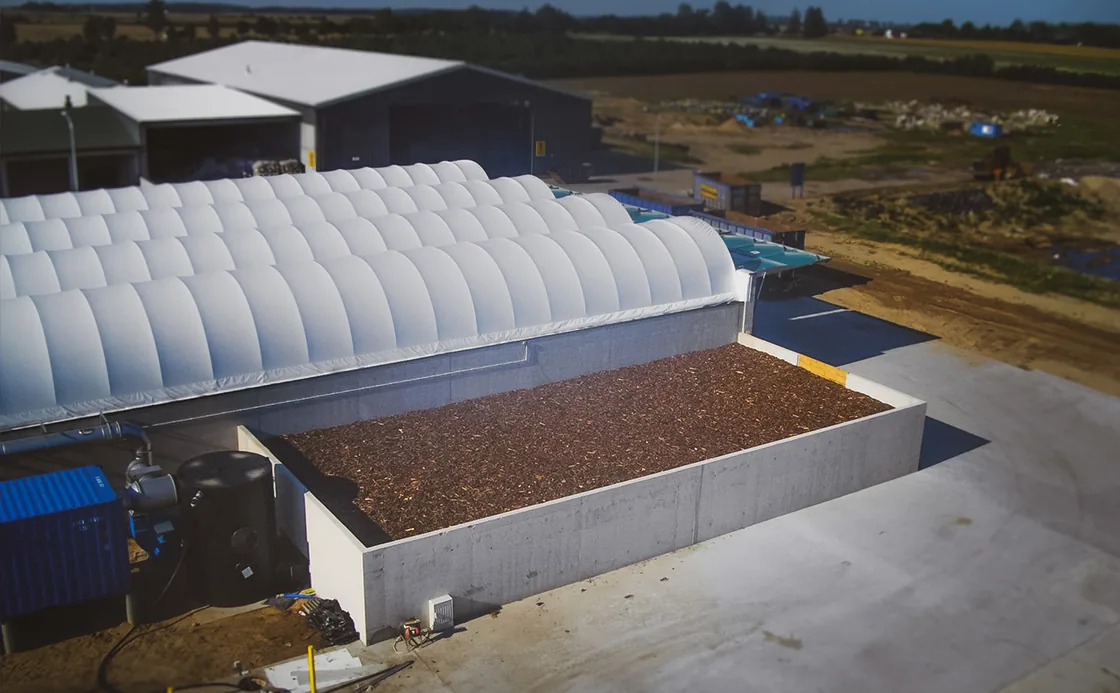
Capture means directing air from the source area to the treatment system. In an enclosed building or piece of equipment, extraction can maintain a lower pressure than outdoors. When ventilation controls the air path effectively, outside air enters through designated openings and process air moves towards the extraction points. Check this while doors are opening and when processes change the airflow. A membrane can limit some diffuse emissions; it does not in itself ensure that air is captured and sent for treatment. Negative aeration through the floor provides a route to capture air drawn through the material, but does not automatically capture emissions from receiving, transfers or turning. For example, exhaust discharged through a stack is a channelled emission, while air escaping uncontrolled through a doorway or from an outdoor windrow gives rise to diffuse emissions. Under the definitions in European Commission Implementing Decision 2018/1147, emissions from open-top biofilters are classed as channelled even if there is no stack. [2, 3, 5]
Treatment can reduce certain compounds in the captured air. Performance depends on gas composition, airflow distribution and contact time in the filter bed. A biofilter distributes air through a moist, porous bed. Some compounds are retained on the filter media or pass into the water film, where microorganisms can break them down. If the bed dries out, compacts or develops cracks that let air bypass the rest of the bed, treatment can become uneven. High concentrations of ammonia or certain sulphur compounds can change the bed's pH and limit performance. Once the gas stream has been characterised, a scrubber may be needed upstream of the biofilter. Good removal of one compound or of odour does not demonstrate removal of all pollutants. [2, 3, 7]
| What you observe | What to check | What to adjust if the cause is confirmed |
|---|---|---|
| Odour at the building doors, especially during unloading | Airflow direction at the opening, differential pressure under those conditions, extraction status and how long doors are open. | Adjust door operation or extraction within design limits, then recheck capture during unloading. |
| Stronger odour at the outlet and rising pressure drop across the bed at comparable airflow | Possible compaction, dust build-up or insufficient drainage; check air distribution as well as the pressure reading. | Correct drainage or maintain the bed according to its design, then repeat the measurements. |
| Dry areas or cracks on the biofilter surface | Bed moisture in several locations, inlet-air humidification, irrigation and airflow distribution. | Address the cause of drying and restore distribution through the bed. A wet-looking surface does not show that the entire bed is evenly moist. |
Worked example: duct airflow and the limits of a stated removal efficiency
If the free internal area of the duct is 2 m² and the average velocity across that section is 0.30 m/s, the volume flow under the measurement conditions is Q = 2 × 0.30 = 0.60 m³/s, or 2,160 m³/h. This assumes a representative cross-sectional average and reasonably steady conditions. A single local velocity reading is not necessarily the average, and the calculation tells you neither the odour concentration nor the biofilter's efficiency. To determine the odour emission rate at the outlet, you need both odour concentration measured by dynamic olfactometry and gas volume flow, expressed on compatible bases. The result is not the concentration someone breathes at the site boundary. [4, 7]
In a separate example, suppose a source generates 100 g/h of one compound. Capture delivers 70 g/h to the biofilter, which removes 80% of that captured mass flow. The filter removes 56 g/h; 14 g/h remains at its outlet and 30 g/h escapes as diffuse emissions. The overall reduction is 56%, not 80%. This is an illustrative mass balance for a single compound at steady state, with no other sources or transformations outside the equipment. It cannot be used to add odour intensities, size equipment or guarantee performance.
How to investigate a report
Record the time, location and duration of the incident. If weather data is available, check where the wind was coming from and how fast it was blowing: could it have carried air from the facility towards the location in the report? Compare this information with the site log: what material was unloaded, which batch was turned, which doors were open, whether the air treatment system was running and at what flow rate. Timing alone does not establish the source. After taking corrective action, repeat the checks under comparable conditions. For example, while material is being unloaded with the reception hall door open, check and record whether outside air is flowing in or air from the hall is escaping through the opening. Outward flow can indicate a loss of capture at the door, but does not prove that it was the source of the reported odour. If work was carried out on the treatment system, compare the outlet concentration and airflow before and after maintenance. [3, 4]
To check treatment performance, compare representative measurements at the inlet and outlet under documented operating conditions. To assess the mass flow of a compound, use both concentrations and flow rates on compatible bases; a lower outlet concentration alone does not establish that less mass is emitted per hour. For impact assessment or compliance testing, check the requirements applicable to the facility and any measurement methods specified in its permit. Operator observations help locate a problem, but do not replace emissions measurements or dispersion assessment. [2–4]
See also feedstocks and contaminants, mix preparation, oxygen, porosity and aeration, composting technologies and process monitoring and troubleshooting.
References and further reading
- NC State University Extension. Large-Scale Organic Materials Composting, sections on process factors and odour management
- European Commission. Implementing Decision (EU) 2018/1147, “Scope” and “Definitions” sections and BAT 33, 34 and 37: feedstock selection and emissions control
- Environment Agency. Biological waste treatment: appropriate measures for permitted facilities, sections 11.6 and 11.8: biofilters, monitoring and capture of diffuse emissions; technical guidance for England
- Environment Agency. Odour management: Assessing odorous emissions, sections on olfactometry, chemical indicators, flow rates and the limits of process control readings; technical guidance for England
- Environment Agency. Biological waste treatment: appropriate measures for permitted facilities, section 8.6, “Static-pile aeration”: aeration control and the direction of suction through the material; technical guidance for England
- Pagans et al. Ammonia emissions from the composting of different organic wastes. Dependency on process temperature (2006), §3.3; laboratory study, not a basis for transferring numeric results to commercial facilities
- International Compost Seminar 2026, Austria, 8 October (day 4). “4.1 Emissions and Their Treatment”, PDF pp. 5–6 and 19–22; “4.2 Biofilter”, PDF pp. 3, 5 and 16–23. Organiser: Compost Systems GmbH. Pages consulted in the text extracts.